By Tamsi Besson ·
Qwen 3.8 27B — the open 27B that pulls the frontier onto local hardware
Qwen3.8-27B specs, official scores versus 3.6 and Opus 4.6 Max, and what that changes for local AI.
- Qwen
- Local LLM
- Open source
- Benchmarks
Qwen3.8-27B shipped mid-August 2026: a dense 27B under Apache 2.0, native multimodal, 262k context. Not a 2T MoE — a model you can download and serve. The model card puts it above Qwen3.6-27B everywhere, and above Claude Opus 4.6 Max on several coding and agent benches. Vendor numbers, treat them as a ceiling until independent labs reproduce them — but the signal for local AI is clear.
Specs
The 27B is the compact dense model in the Qwen3.8 generation, built on the Qwen3.5 architecture: 64 layers, hybrid attention (16 Gated Attention blocks, the rest linear Gated DeltaNet), a vision encoder, multi-token prediction. Apache 2.0, open weights, meant for deployment — not only a cloud API.
- 27B dense (≈28B with the vision tower), 64 layers, hidden 5120, vocab 248,320.
- Native context 262,144 tokens, extensible to 1,000,000 via YaRN.
- Native multimodal: images and video (docs, STEM diagrams, long videos).
- Thinking on by default, tunable with
reasoning_effort(xhigh / medium / low) andpreserve_thinking. - Served by vLLM 0.17+, SGLang, Transformers ≥ 5.8; community MLX / GGUF / NVFP4 / FP8 quants on day zero.
What the benches say
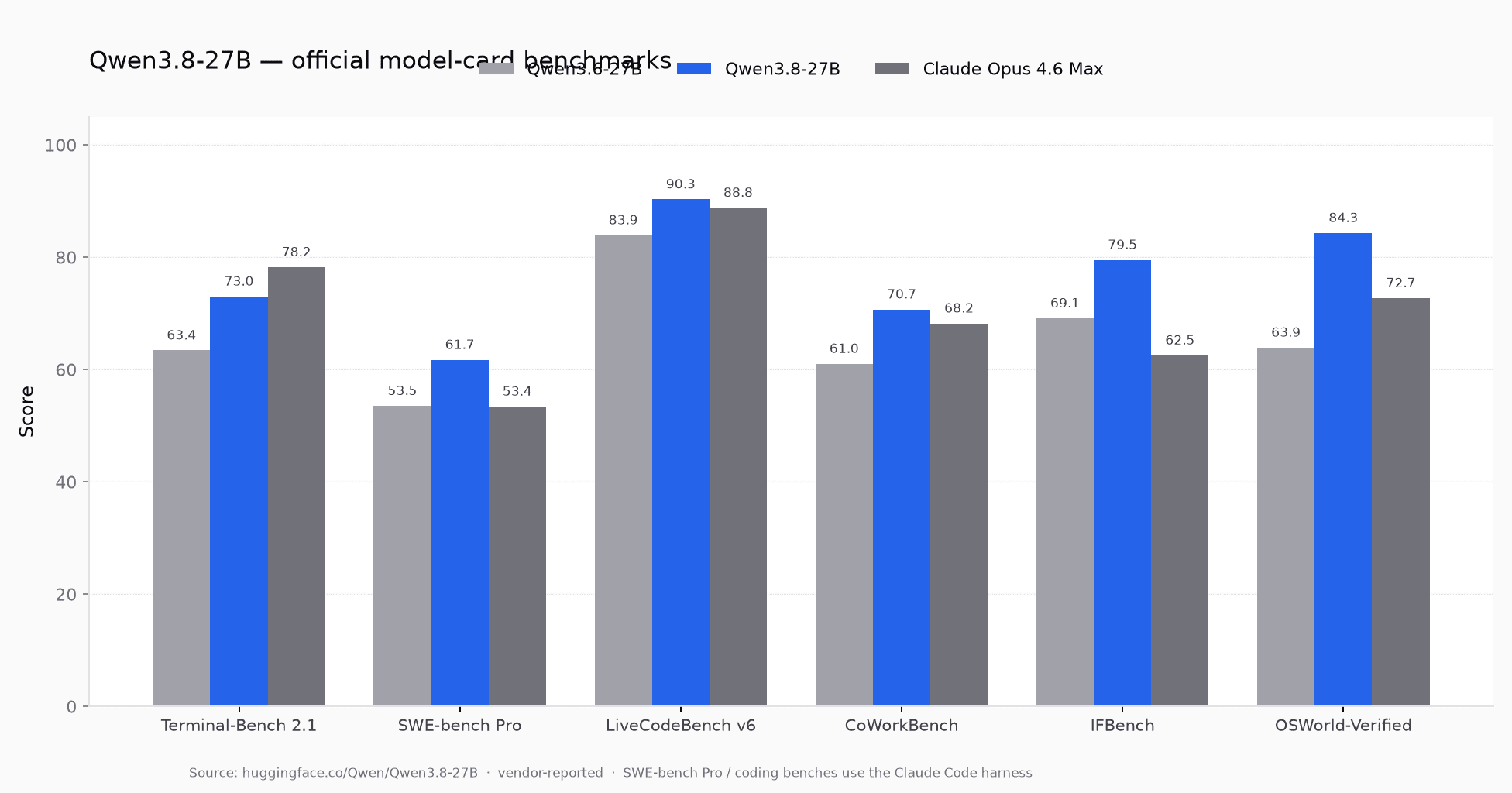
On the official card, the jump versus 3.6 is mostly agentic and coding. DeepSWE 1.1 goes from 13.3 to 42.2. QwenSWEBench from 49.3 to 79.0. SWE-bench Pro 61.7 vs 53.5 (and 53.4 for Opus 4.6 Max, different harness for Opus). LiveCodeBench v6 90.3 vs 83.9. On vision / computer use: OSWorld-Verified 84.3 vs 63.9.
- Terminal-Bench 2.1: 73.0 (3.6: 63.4 — Opus: 78.2).
- SWE-bench Pro: 61.7 (3.6: 53.5 — Opus: 53.4).
- LiveCodeBench v6: 90.3 (3.6: 83.9 — Opus: 88.8).
- CoWorkBench: 70.7 (3.6: 61.0 — Opus: 68.2).
- IFBench: 79.5 (3.6: 69.1 — Opus: 62.5).
- OSWorld-Verified: 84.3 (3.6: 63.9 — Opus: 72.7).
Opus still leads on Terminal-Bench, GPQA Diamond (91.3 vs 89.2), and Humanity’s Last Exam. The 27B is not “better than Opus everywhere.” It is close enough, on enough engineering tasks, that an open 27B changes the local-versus-API math.
Impact on local AI
Until now, local mostly won on volume: small models, aggressive quants, short tasks. Frontier agent work (large diffs, computer use, tool loops) stayed metered. A 27B Apache model posting coding / SWE scores next to a cloud Opus, running FP8 on a 48 GB card or 4-bit on a laptop, moves that line.
- No license to negotiate, no quota cutting an agent session mid-refactor.
- 262k native context: a repo, not a file, fits in a local window.
- Vision + computer use (OSWorld, WebArena, AndroidWorld): local is no longer text-only.
- Day-zero quants (Unsloth, MLX, GGUF, NVFP4): the same weights go from a Mac to a vLLM box.
- Controllable thinking: you pay for reasoning only when the task justifies it.
That doesn’t kill APIs. It makes it reasonable to keep daily work — review, proto, MCP, Hermes — on a machine you control. 3.6 already pushed me toward self-hosted vLLM; 3.8 makes that choice less of a quality compromise.
A local run
I ran it in MLX 4-bit inside Unsloth Studio on a 32 GB M1 MacBook. Not a bench: an HTML Tetris, ~11 tok/s, fast enough to iterate. Notes here: x.com/tamsi_besson/status/2089656034449080484
Takeaway
Qwen 3.8 27B is not a size miracle. It is an open dense multimodal long-context model whose official coding and agent scores sit next to cloud flagships. For local AI, this is the rung where “self-host a 27B” stops being a hobby and becomes an engineering option. Independent reproductions will say whether the bars hold; the weights are already here.
- Model card: huggingface.co/Qwen/Qwen3.8-27B
- Local run: x.com/tamsi_besson/status/2089656034449080484
- Studio: /blog/unsloth-studio
- 3.6 server: /blog/qwen-3-6-27b-remote-server