By Tamsi Besson ·
Why I’m moving to Hermes — automate with cheaper models
Fable 5 just landed and tops the Cursor benchmark at a steep price: I’m shifting agentic work to Hermes and affordable models.
- Hermes
- Cursor
- Coût
- Automation
I like Cursor as an IDE. Agent billing is harder to justify: every long session, refactor, or MCP loop adds up — especially now that Anthropic shipped Fable 5 and Cursor pushes it as the default high-end model.
Fable 5: great scores, steep cost
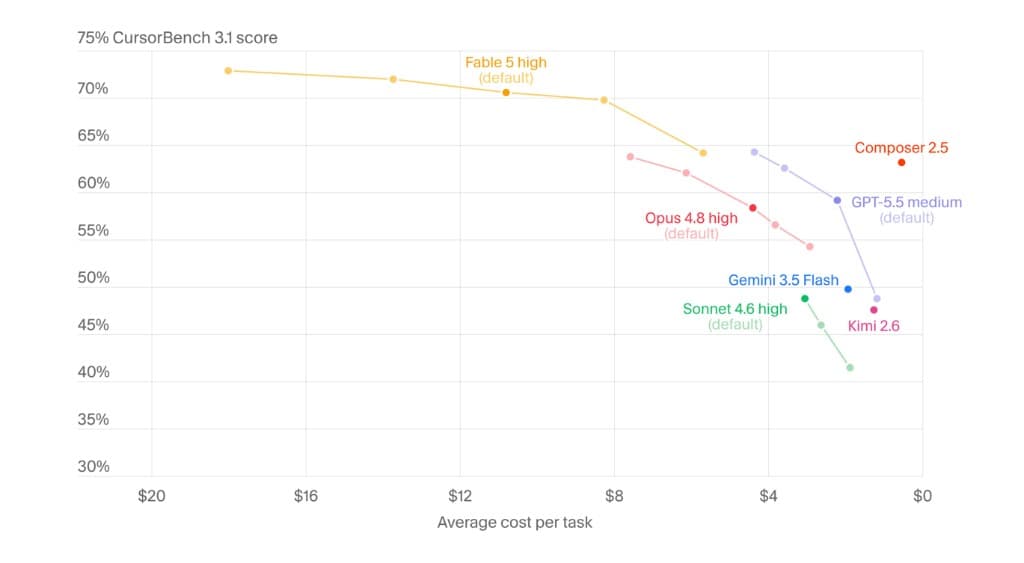
The CursorBench 3.1 chart says it all: Fable 5 high (default) sits top-left — best score (~71%), around $12 per task. Composer 2.5 or GPT-5.5 medium land near ~60% for $1–3. Over a full dev day, that gap is real money.
Why Hermes joins the loop
Hermes Agent (Nous Research) isn’t a Cursor replacement — it’s the layer that automates outside the IDE: persistent skills, memory, webhooks, recurring jobs. I use it for work that shouldn’t need a “Continue” click every two minutes, wired to models I control (Qwen on vLLM/AWS, Ollama locally) instead of Fable 5 on every prompt.
- Repeat tasks (repo watch, API checks, validation scripts) → Hermes + smaller model.
- Heavy agent sessions in Cursor → my Qwen endpoint, not the built-in premium model.
- MCP for day job (redbee, code review) → same OpenAI-compatible stack, fixed GPU cost.
- Hermes to chain tools without paying the “flagship model” tax at every step.
In practice
Cursor stays my editor. Hermes owns workflows that outlive a chat: pipelines, reminders, Firebase/Slack hooks, skills learned once and reused. Today’s trigger is Fable 5: great benchmark, pricing that pushes agentic work off Cursor’s most expensive marketplace models.
Bottom line
This isn’t “anti-Cursor” or “anti-Anthropic.” It’s using the right model in the right place. Flagship in Cursor for a one-off if needed; Hermes + cheap models for daily automation. My token budget is happier, and I keep control of the stack.